Fotona Laser Treatments for Non-Invasive Skin Tightening
Skin tightening sits in an awkward middle ground in aesthetic medicine. Patients often want a visible lift, smoother texture, and firmer contours, but many are not ready for surgery, injectable volumizing, or aggressive resurfacing that comes with a long recovery. That gap is exactly where Fotona Laser Treatments have built a strong reputation. When used well, they can improve laxity, refine crepey texture, and stimulate collagen without incisions or significant downtime.
What makes this category interesting is that it is not one single treatment in the way many people assume. Fotona is a laser platform, and the results depend on the wavelength, pulse mode, treatment depth, energy settings, treatment pattern, and the clinician’s judgment. Two patients can both say they had a “Fotona treatment” and mean very different things. One may have had a gentle collagen-stimulating session with mild warmth and no visible peeling. Another may have undergone a much more intensive tightening and resurfacing protocol around the eyes or lower face.
That distinction matters, because non-invasive skin tightening is less about hype and more about matching the right technology to the right problem.
Why Fotona stands out in skin tightening
Most non-invasive tightening devices work by delivering controlled heat into tissue. The goal is straightforward. Heat the skin and deeper dermal structures to a therapeutic range, trigger a wound-healing cascade, and encourage collagen remodeling over time. The challenge is doing enough to create a measurable change without injuring the surface or causing prolonged recovery.
Fotona systems are widely used because they offer versatility. Many protocols combine erbium:YAG and Nd:YAG wavelengths, each with different tissue interactions. In practical terms, that means the provider can work more superficially for textural refinement, more deeply for bulk heating and collagen stimulation, or combine both in one treatment plan.
In clinic, that flexibility becomes useful very quickly. A patient in their late thirties with early jawline softening usually needs something different from a patient in their fifties with thinner skin around the eyes, deeper folds, and years of cumulative sun exposure. One setting does not suit both. A platform that allows layered treatment is often more effective than a one-note device.
Another reason patients gravitate to Fotona Laser Treatments is the recovery profile. For many tightening-focused protocols, downtime is limited. Some people leave pink for a few hours. Others look slightly flushed until the next day. More intensive versions can involve a few days of swelling or a sandpaper-like texture, especially if resurfacing is added, but it is still far lighter than surgical recovery and often easier than medium-depth ablative procedures.
How the treatment actually tightens skin
The phrase “stimulates collagen” gets repeated so often that it risks becoming meaningless. It helps to be more specific.
As skin ages, collagen fibers become fragmented and less organized, elastin quality declines, and the support architecture in the dermis weakens. On the surface, that shows up as fine wrinkling, looseness under the chin, smile lines that linger when the face is at rest, or a gradually heavier look around the lower cheeks. Heating the tissue in a controlled way can produce two useful effects.
First, there can be an immediate but modest contraction of existing collagen. This is not a facelift effect, but some patients notice a subtle firmness fairly early. Second, and more importantly, the thermal injury prompts fibroblasts to produce new collagen over the following weeks and months. This remodeling phase is where the better tightening results come from.
With Fotona systems, one common strategy is to deliver deep bulk heating using Nd:YAG energy, then refine the superficial layers with erbium:YAG. Some practices also perform intraoral treatment for the perioral area and nasolabial region, heating tissue from inside the mouth to support collagen remodeling without breaking the skin surface externally. Patients are often surprised by that part, but it can be quite useful for upper lip lines and cheek support.
The key point is that skin tightening is gradual biology, not instant architecture. If someone expects the dramatic repositioning of a surgical lift, a laser is the wrong tool. If they want firmer skin, softer fine lines, and a healthier, denser quality to the skin envelope, this approach can make sense.
What areas respond best
The face gets most of the attention, but some of the most satisfying improvements happen in places people mention only after the consultation starts. The lower eyelids, crow’s feet area, upper lip, jawline, neck, and the skin just under the chin are common targets. On the body, mild laxity above the knees, on the abdomen after weight changes, and on the upper arms can sometimes respond, though body results are usually less dramatic and often require more sessions.
The eye area deserves special mention. This is one of the regions where modest tightening can make a person look notably fresher. A patient does not need severe hooding to feel bothered by crepey lids or makeup collecting in fine lines. Properly selected laser tightening in this zone can improve texture and skin quality with less downtime than many people expect. It is also an area where experience matters enormously, because the skin is thin and over-treatment is unforgiving.
Around the mouth, Fotona Laser Treatments are often chosen for patients who dislike the etched lines that lipstick can settle into. If those lines are caused mainly by repetitive movement and skin thinning, lasers can help. If the issue is more structural volume loss or deep static folds, the treatment usually works best as part of a broader plan rather than as a standalone fix.
Who tends to be a good candidate
The best candidates are not always the youngest or the oldest. They are the ones with realistic expectations and mild to moderate laxity. Early skin looseness, textural aging, fine lines, and crepey changes tend to respond better than heavy sagging or large-volume descent.
A practical way to think about candidacy is to look at what bothers the patient most. If they say, “My skin feels thinner, less springy, and a bit loose,” that is often a good laser conversation. If they say, “I want my jowls gone and my neck pulled tight,” surgery may be the more honest answer.
Skin type also matters. Providers need to adjust parameters carefully in patients with higher melanin content to reduce the risk of post-inflammatory hyperpigmentation or thermal injury. That does not mean darker skin tones cannot be treated. It means planning and device selection must be thoughtful. Pre-treatment skincare, conservative test areas in select cases, and disciplined aftercare can make a meaningful difference.
Recent tanning, active infections, uncontrolled inflammatory skin disease, and certain medications can complicate treatment timing. So can a history of abnormal scarring, though that concern is more relevant to resurfacing than to non-ablative tightening.
What a session feels like
Patients usually ask two things first. Does it hurt, and how long will I look strange?
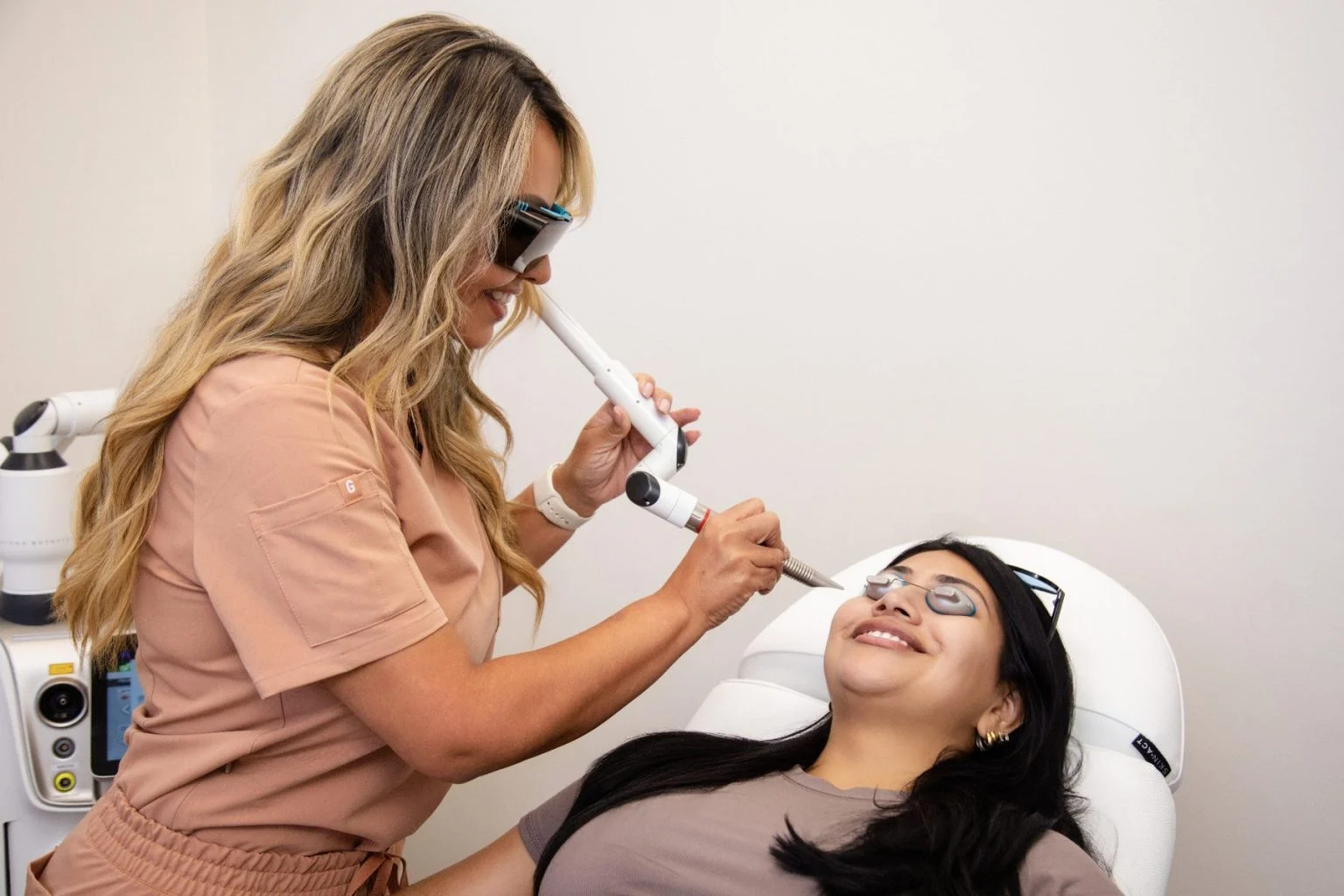
The sensation depends on the protocol. Deep heating treatments often feel like repeated bursts of warmth, occasionally bordering on hot snaps. Most people tolerate them well with topical numbing, chilled air, contact cooling, or short treatment breaks. Around the mouth and eyes, sensitivity can be higher. Intraoral passes feel unusual more than painful, though they are not exactly relaxing. More intensive erbium-based work can produce a stronger stinging or prickling sensation, especially when treating surface irregularities and fine lines.
Treatment time varies by area. A focused periorbital session may be finished in under half an hour. A combined full-face tightening treatment can run longer, especially if multiple passes or layered protocols are used.
Immediately afterward, the skin often looks pink and feels warm, similar to a lingering sun-flush. Swelling is usually mild but can be more noticeable around the eyes the next morning. For office workers and parents who need to return to normal life quickly, this manageable recovery is often the deciding factor.
Results are cumulative, and that is both the strength and the weakness
Non-invasive treatments ask for patience. That is their great virtue and their main limitation.
Because collagen remodeling takes time, visible improvement unfolds gradually. Some patients notice a tighter feel within days, but the more meaningful changes tend to appear over six to twelve weeks and can continue evolving after that. For people who want natural-looking improvement, this slow build is ideal. Friends may comment that they look rested or healthier without immediately guessing they had a procedure.
The trade-off is obvious. Gradual improvement can feel underwhelming to someone who expected a one-session transformation. Managing this expectation is one of the most important parts of treatment planning.
In practice, many patients do best with a short series rather than a single appointment. A common approach is two to four sessions spaced several weeks apart, then maintenance once or twice a year depending on age, skin quality, and lifestyle factors like sun exposure, smoking history, and weight fluctuations. There is no magic number that fits everyone. A 42-year-old with early laxity and good baseline skin may respond beautifully to a conservative plan. A 61-year-old with significant photodamage may need more sessions and still achieve a subtler endpoint.
Where Fotona fits compared with other options
Patients rarely compare laser tightening in a vacuum. They are usually deciding between several paths, each with different costs, downtime, and ceiling of improvement.
Radiofrequency microneedling is a frequent alternative. It combines thermal injury with mechanical needling and can be excellent for acne scarring, pores, and moderate tightening. Ultrasound-based devices are another category, often used to target deeper tissue planes. Then there are injectables, thread lifts, chemical peels, and surgery.
The right choice depends less on branding and more on anatomy. If the main issue is poor surface texture and early laxity, a laser-based collagen remodeling plan is often logical. If the issue is volume loss in the midface, filler or biostimulatory injectables may address the complaint more directly. If the neck has pronounced banding and excess skin, no energy device will truly replicate a neck lift.
This is where honest consultation matters. Strong practices do not force every problem into one device. They explain what a treatment can improve, what it will leave untouched, and whether combination therapy makes more sense.
The subtle art of combining treatments
Some of the best results I have seen came from restraint rather than aggressiveness. A patient does not always need the strongest possible laser setting. Sometimes the smarter move is to use moderate energy for tightening, then support the result with targeted skincare, neuromodulators, or conservative volume restoration.
For example, a patient with mild lower-face laxity, etched upper-lip lines, and sun-damaged skin might benefit from staged care. Tightening first, then selective resurfacing later, often creates a more balanced outcome than trying to solve every issue in one intense session. Likewise, jawline softening can improve more when skin quality, muscle pull, and structural support are all addressed instead of expecting a laser alone to do all the work.
Combination planning is especially useful in patients over fifty, where aging is usually layered. There may be skin laxity, yes, but also bone resorption, fat pad descent, repetitive muscular folding, and vascular or pigment changes. Lasers improve one part of that equation very well. They do not erase the rest.
Common benefits patients actually notice
When the treatment is well selected, the changes people report are often specific rather than dramatic. They mention that makeup sits better under the eyes. The skin at the jawline feels less slack when washing the face. Lipstick bleeds less into vertical lip lines. The neck photographs more smoothly in side lighting. These details matter because they reflect real-world improvement, not just before-and-after photography under controlled conditions.
The broader benefits often include the following:
- Mild to moderate firming of loose skin on the face, neck, or around the eyes
- Softening of fine lines and crepey texture
- Better overall skin quality, with a denser, smoother feel
- Little to moderate downtime compared with more aggressive procedures
- A natural progression of results rather than a sudden altered appearance
None of these should be confused with surgical lifting. Patients who understand that distinction are usually the happiest.
Risks, limits, and the mistakes that lead to disappointment
No energy-based treatment is risk-free. The most common issues are temporary redness, swelling, dryness, and sensitivity. In more intensive treatments, there can be bronzing, pinpoint crusting, or a rough texture for several days. Less commonly, patients can develop post-inflammatory hyperpigmentation, prolonged erythema, acne flares, herpes simplex reactivation, or, in rare cases, scarring if settings are too aggressive or aftercare is poor.
The bigger problem, though, is not usually injury. It is mismatch. Wrong patient, wrong depth, wrong endpoint.
A thin-skinned patient with significant lower-face descent can spend considerable money on a series of non-invasive treatments and still feel disappointed because the treatment did exactly what it was capable of, but not what they hoped for. On the other hand, a younger patient with early laxity can see a genuinely worthwhile improvement from a modest plan and wonder why they waited so long.
Sun exposure after treatment is another frequent issue. It sounds mundane, but it matters. A beautifully timed laser series can be undermined by poor photoprotection, especially in patients prone to pigment changes. Good sunscreen, shade habits, and gentle skincare are not glamorous, but they protect the investment.
Preparing well improves outcomes
Preparation does not need to be elaborate, but it should be deliberate. Skin that is calm, well hydrated, and not recently irritated tends to recover better than skin that has been over-exfoliated, tanned, or inflamed.
A sensible pre-treatment routine often includes the following:
- Avoid active tanning and minimize sun exposure for at least a couple of weeks
- Pause irritating topicals if your provider advises it, especially strong retinoids or acids near treatment time
- Mention any history of cold sores, unusual scarring, or pigment problems before booking
- Arrive with clean skin and realistic expectations about gradual improvement
- Follow aftercare closely, especially regarding moisturization, heat exposure, and sunscreen use
That may sound basic, but basic habits are where many avoidable setbacks begin.
What aftercare usually looks like
Most patients can resume normal cleansing and moisturizing very quickly, though exact instructions vary by protocol. The first day or two are usually about reducing unnecessary heat and friction. That means lukewarm water rather than hot showers directly on the treated area, no harsh exfoliants, and a temporary pause on vigorous workouts if swelling is present.
If the treatment included more noticeable resurfacing, the skin can feel dry or rough for several days. This is the phase where patients get impatient and start rubbing or picking. They should not. A bland moisturizer, sun avoidance, and patience tend to do more good than a shelf full of active products.
Makeup timing depends on the intensity of treatment. For lighter sessions, some patients wear it the next day. For stronger ones, a provider may suggest waiting longer. Again, the recovery conversation should be individualized rather than generic.
Cost and value, viewed realistically
Cost varies widely by region, provider expertise, treatment area, and whether the protocol includes combined modes or https://augustznlr372.wpsuo.com/everything-to-consider-before-starting-fotona-laser-treatments specialty passes such as intraoral tightening. A single session may sound reasonably priced until someone learns that they will likely need a series. Conversely, a more expensive treatment can still represent good value if it meaningfully improves a concern that daily skincare never could.
The smartest way to judge value is not by price per session alone. It is by price relative to likely outcome. A cheaper treatment that has little chance of helping your specific anatomy is not a bargain. Neither is an expensive package sold with exaggerated promises.
Patients do best when they ask direct questions. How many sessions are typically needed for this exact concern? What degree of improvement is realistic? Is this the best option for my anatomy, or simply one option? Those answers reveal the quality of the consultation quickly.
The bottom line on Fotona Laser Treatments
Fotona Laser Treatments occupy a useful and credible space in non-invasive skin tightening. They are not magic, and they are not a substitute for surgery when surgery is truly indicated. What they can do, when chosen well and performed skillfully, is improve skin firmness, texture, and overall quality with a recovery profile that fits real life.
Their strongest results tend to appear in patients with early to moderate laxity, fine wrinkling, crepey skin, and a preference for gradual, natural change. Their biggest weaknesses show up when they are oversold to patients who need structural lifting rather than collagen remodeling.
That is why expertise matters more than branding. The machine matters, yes, but the assessment matters more. A thoughtful provider will look at the whole face, the skin quality, the degree of descent, the patient’s timeline, tolerance for downtime, and long-term goals. Sometimes Fotona is the right answer. Sometimes it is part of the answer. Sometimes the most professional answer is no.
For patients who want firmer skin without stepping into surgery, that kind of honesty is worth almost as much as the treatment itself.
OMNIA Wellness Center
Address: 16430 Ventura Blvd Ste 207, Encino, CA 91436
Phone number: +18183868511
FAQ About Fotona Laser Treatments
What is a Fotona laser good for?
A Fotona Laser system is a versatile, dual-wavelength medical laser used primarily for non-surgical skin tightening, anti-aging rejuvenation, and dermatological treatments.
How much does the Fotona laser cost?
The cost of a Fotona laser depends heavily on whether you are looking to purchase a laser machine for a medical practice or are a patient seeking a laser treatment at a medspa.
Is a Fotona laser worth it?
A Fotona laser treatment is generally worth it if you want non-surgical skin tightening, improved texture, and collagen stimulation with very little downtime.